Love Alone
— Sayings of Light and Love
In the evening of life, we will be judged on love alone.
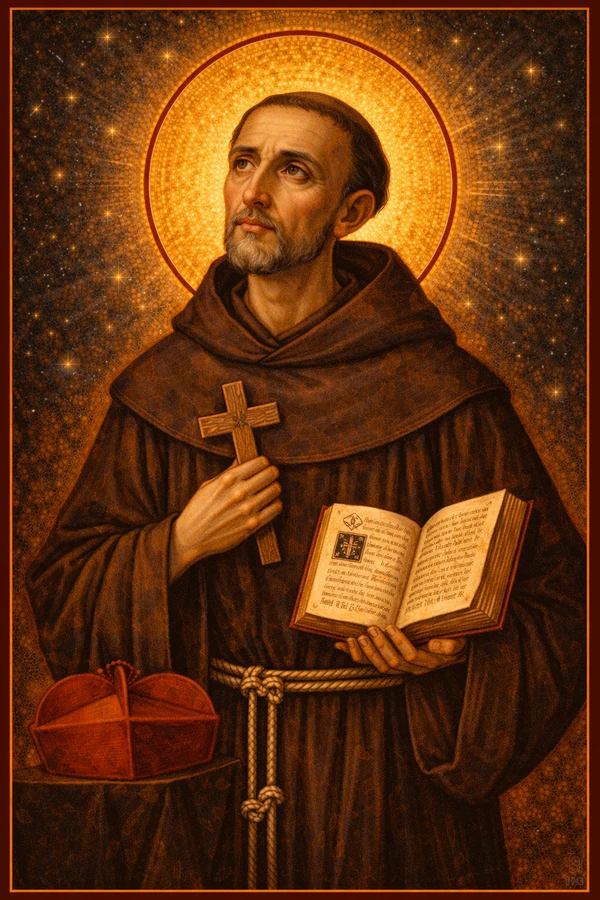
John of the Cross
Biography, major works, and key teachings
John of the Cross was a Carmelite mystic and poet whose writings on the dark night of the soul became the definitive account of spiritual purification in the Christian tradition.
Biography
About
John of the Cross was a Carmelite mystic and poet whose writings on the dark night of the soul became the definitive account of spiritual purification in the Christian tradition.
Life
Born Juan de Yepes in 1542 in Fontiveros, Spain, to a family impoverished after his father married beneath his social class, John knew deprivation from childhood. He studied at a Jesuit school, entered the Carmelite order at twenty-one, and was ordained a priest in 1567. That same year he met Teresa of Ávila, who persuaded him to join her reform of the Carmelite order. His commitment to the reform brought severe consequences: in 1577 he was kidnapped by unreformed Carmelites and imprisoned in a tiny cell in Toledo for nine months, beaten regularly, and nearly starved. It was in this darkness — literal and spiritual — that he composed some of the greatest poetry in the Spanish language. After his escape he continued to lead reformed communities, but toward the end of his life he was again marginalized by factions within his own order. He died in 1591 at forty-nine, in a monastery where the prior refused him even basic comforts in his final illness.
Theological Vision
John's theology is a theology of subtraction. The dark night is not simply suffering — it is the systematic removal of everything that is not God. In the Ascent of Mount Carmel and the Dark Night of the Soul, he describes two purgations: the dark night of the senses, in which the soul's attachment to sensory consolation is stripped away, and the dark night of the spirit, in which even spiritual consolation — the felt presence of God, the joy of prayer — is withdrawn. What remains when everything has been taken is not emptiness but God himself, encountered in a way that transcends all previous experience. The Living Flame of Love, his final major work, describes the soul's union with God in language of extraordinary tenderness and intensity. John insists that this union is available not only to monks but to anyone willing to undergo the purgation. His poetry — especially the Spiritual Canticle and the Dark Night — achieves what his prose explains: a direct encounter with the inexpressible.
Influence
John of the Cross was declared a Doctor of the Church in 1926. His account of the dark night has become the standard reference point for spiritual desolation in Christian theology and beyond — the phrase itself has entered common language. His poetry is regarded as the summit of Spanish mystical literature, and his theological vision of purification through love continues to guide contemplative practice across Christian traditions.
Major Works
The phrase 'dark night of the soul' has entered common language, but its original meaning is far more precise — and more hopeful — than most people realize. John of the Cross describes two purgations: the dark night of the senses, in which the soul's dependence on emotional consolation is withdrawn, and the dark night of the spirit, in which even the felt presence of God disappears. These are not punishments but acts of love — God removing what is not God so that the soul can receive God directly. The work is a commentary on John's own poem, composed during nine months of imprisonment in a cell barely large enough to stand in. The prose is systematic and sometimes demanding, but the underlying vision is one of extraordinary tenderness: the darkness is not God's absence but the overwhelming proximity of a light too bright for the soul's accustomed sight. For anyone who has experienced the collapse of spiritual feeling and wondered whether God has departed, this book offers the most profound answer the Christian tradition has produced.
The companion work to the Dark Night, presenting John of the Cross's systematic account of the active purification that prepares the soul for contemplative union. Where the Dark Night describes what God does to the soul, the Ascent describes what the soul must do for itself: the voluntary detachment from sensory gratification, intellectual pride, and spiritual ambition that clears the ground for God's deeper work. John's famous principle — 'To come to possess all, desire to possess nothing' — is not nihilism but the logic of love: attachment to anything less than God prevents the soul from receiving God fully. The work is demanding and sometimes austere, but its underlying conviction is that freedom, not deprivation, is the goal. John is stripping away what enslaves, not what gives life.
John of the Cross's most lyrical work — a poem of forty stanzas modeled on the Song of Songs, followed by a prose commentary that unfolds each image into theological meaning. The Bride (the soul) searches for the Beloved (Christ) through all of creation, finds him, loses him, and finds him again in a union that transforms everything. The poetry achieves what John's prose treatises explain: a direct encounter with the inexpressible. The Spiritual Canticle was composed in fragments, some stanzas written during John's imprisonment in Toledo, others added later. Its beauty is inseparable from the suffering that produced it. For readers who find the systematic prose of the Ascent and the Dark Night demanding, the Canticle offers the same theology in the language of desire, longing, and consummation.
John of the Cross's final major work, and the most radiant. Where the Dark Night describes the painful purification of the soul, the Living Flame describes what lies on the other side: the soul fully aflame with the Holy Spirit, experiencing the deepest union with God possible in this life. The four stanzas of the poem — each a single exclamation of love — are among the most intense lines in mystical literature. The commentary unfolds them with a gentleness that surprises readers accustomed to the severity of the earlier works. John writes here not as a guide through darkness but as a witness to arrival. The Living Flame is best read last, after the Ascent and the Dark Night, as the destination those journeys were always pointing toward.
Quotes
Selected passages drawn from the writings of John of the Cross.
In the evening of life, we will be judged on love alone.
Sayings of Light and Love — 57
To come to possess all, desire to possess nothing. To come to be all, desire to be nothing.
Ascent of Mount Carmel — I.13.11
O guiding night! O night more lovely than the dawn! O night that has united the Lover with His beloved, transforming the beloved in her Lover.
Dark Night of the Soul — Stanza 5