Let Nothing Disturb You
— Bookmark Prayer
Let nothing disturb you, let nothing frighten you, all things are passing; God never changes.
More Prayers
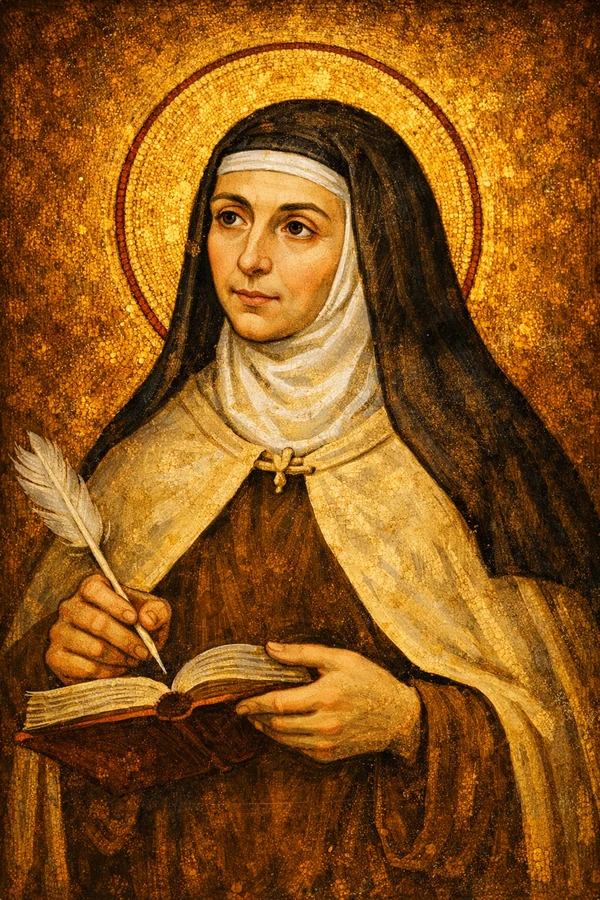
Teresa of Ávila
Biography, major works, and key teachings
Teresa of Ávila was a Carmelite reformer and Doctor of the Church whose writings on prayer remain the most vivid and practical guide to the contemplative life in the Christian tradition.
Biography
About
Teresa of Ávila was a Carmelite reformer and Doctor of the Church whose writings on prayer remain the most vivid and practical guide to the contemplative life in the Christian tradition.
Life
Born Teresa de Cepeda y Ahumada in 1515 in Ávila, Spain, to a family of converso (Jewish convert) ancestry, Teresa entered the Carmelite Monastery of the Incarnation at twenty. For nearly two decades she lived an unremarkable religious life, struggling with illness and what she later described as a divided heart — drawn to prayer but unable to sustain it. Her conversion deepened in her early forties through a series of mystical experiences that she initially distrusted and submitted to her confessors for discernment. In 1562, at forty-seven, she founded the first reformed Carmelite convent, San José, in Ávila — a tiny community committed to poverty, enclosure, and contemplative prayer. Over the next twenty years, despite constant travel, illness, ecclesiastical suspicion, and the opposition of the Inquisition, she founded sixteen more convents and wrote her major works. She died in 1582 at sixty-seven.
Theological Vision
Teresa's great innovation was to describe the interior life from the inside. In The Interior Castle she presents the soul as a crystal castle with seven groups of mansions, with God dwelling at the center. The journey inward moves from the outer mansions — where the soul is distracted by worldly concerns — through stages of increasing recollection, quiet, and union, to the seventh mansion, where the soul experiences spiritual marriage with God. What makes Teresa's account extraordinary is not the schema itself but the honesty and precision with which she describes each stage: the dryness, the self-doubt, the false humility, the genuine consolations, the terror of the deeper mansions, and the paradoxical freedom of complete surrender. Her definition of prayer — 'an intimate sharing between friends' — is disarmingly simple, but her account of what that friendship demands is as rigorous as any theology in the tradition. She insists that mystical experience is not the point; love is the point, and love is measured by deeds, not feelings.
Influence
Teresa was declared a Doctor of the Church in 1970 — the first woman to receive the title. Her Interior Castle and her autobiography (The Life of Teresa of Jesus) are among the most widely read spiritual classics in any language. Her practical wisdom on prayer, her psychological acuity, and her insistence that contemplative life is not escape from the world but deeper engagement with it have made her a guide for Christians of every tradition.
Major Works
Teresa's masterwork and one of the supreme guides to the contemplative life. Written in 1577 in just a few months, The Interior Castle presents the soul as a crystal castle containing seven groups of dwelling places, with God at the center. The journey inward moves from the outer mansions — where the soul is distracted by worldly attachments — through stages of increasing prayer and recollection, to the seventh mansion, where the soul enters spiritual marriage with God. What makes the work extraordinary is Teresa's psychological precision: she describes not just the heights of mystical experience but the dryness, self-deception, false humility, and genuine terror that accompany deeper prayer. She writes from experience, and she writes for ordinary people, insisting that the door to this castle is open to anyone willing to pray. The Interior Castle is not a theoretical treatise — it is a map drawn by someone who has walked the territory.
Written for her Carmelite sisters at San José, The Way of Perfection is Teresa at her most practical and her most personal. She addresses the three foundations of the contemplative life — mutual love among the sisters, detachment from worldly concerns, and humility — before turning to an extended commentary on the Our Father that becomes a complete guide to prayer. Teresa's voice here is warmer and more informal than in The Interior Castle: she interrupts herself, jokes with her readers, anticipates their objections, and circles back to points she feels she hasn't made clearly enough. The result is a book that feels less like a treatise and more like a conversation with a wise friend who happens to be a mystic.
Teresa's spiritual autobiography, written under obedience to her confessors, recounting her life from childhood through the founding of San José. The Life is remarkable for its honesty: Teresa describes her years of failed prayer, her inability to meditate, her fear that her mystical experiences might be diabolical, and her struggle with what she calls a 'divided heart.' She also describes, with characteristic precision, the stages of prayer she experienced — from vocal prayer through the prayer of quiet to the prayer of union — using the famous image of four ways of watering a garden. The Life was seized by the Inquisition and held for years, which tells you something about its power: a woman writing with this much authority about her direct experience of God was, in sixteenth-century Spain, inherently dangerous.
An account of the founding of the reformed Carmelite monasteries, blending practical narrative with spiritual reflection on providence and trust.
Quotes
Selected passages drawn from the writings of Teresa of Ávila.
The soul is like a castle made entirely of diamond or of very clear crystal, in which there are many rooms, just as in heaven there are many mansions.
The Interior Castle — I.1.1
The important thing is not to think much, but to love much; and so, do that which best stirs you to love.
The Interior Castle — IV.1.7
Christ has no body now on earth but yours, no hands but yours, no feet but yours. Yours are the eyes through which Christ's compassion looks out on the world.
Attributed prayer
Mental prayer is nothing else than a close sharing between friends; it means taking time frequently to be alone with Him who we know loves us.
The Way of Perfection — Ch. 26
Let nothing disturb you, let nothing frighten you, all things are passing; God never changes.
The Way of Perfection — Bookmark found in breviary