Prayer into Divine Darkness
— Adapted from Mystical Theology
Lead me beyond knowledge into the divine darkness where You dwell.
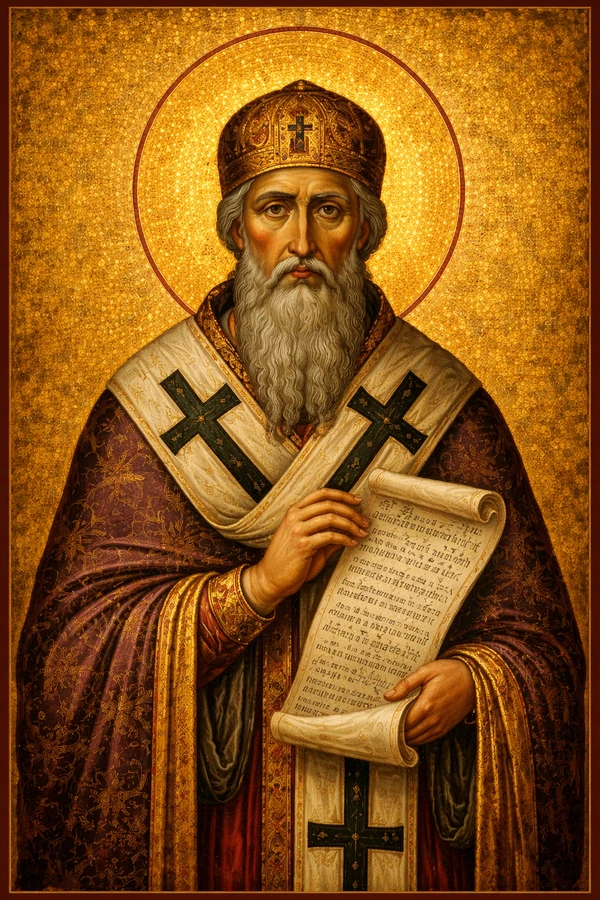
Pseudo-Dionysius the Areopagite
Biography, major works, and key teachings
Pseudo-Dionysius the Areopagite was the anonymous author of a small body of writings that became the most influential source of apophatic — or negative — theology in the Christian tradition.
Biography
About
Pseudo-Dionysius the Areopagite was the anonymous author of a small body of writings that became the most influential source of apophatic — or negative — theology in the Christian tradition.
Life
Almost nothing is known about the author. The writings — The Mystical Theology, The Divine Names, The Celestial Hierarchy, and The Ecclesiastical Hierarchy — appeared around the year 500, attributed to Dionysius the Areopagite, the Athenian convert mentioned in Acts 17:34. This attribution was accepted for a thousand years and gave the texts enormous authority. Modern scholarship has identified the author as an anonymous Syrian monk, probably writing in the circle of Severus of Antioch, deeply influenced by the Neoplatonist philosopher Proclus. The mystery of the author's identity is, in a sense, fitting: these are writings that insist God is encountered precisely where human knowledge — including knowledge of the author — gives way to silence.
Theological Vision
The Mystical Theology, the shortest and most concentrated of the four works, describes the soul's ascent to God as a progressive stripping away of all concepts, images, and affirmations. God is not light — but neither is God darkness. God is not being — but neither is God non-being. Every statement about God must be both affirmed and denied, and then the affirmation and denial must themselves be transcended. What remains is the 'divine darkness' — not ignorance, but a mode of knowing that exceeds the intellect entirely. The Divine Names explores how Scripture's names for God (Good, Beautiful, Being, Life, Wisdom) can be used truthfully while acknowledging that God always exceeds them. The two Hierarchy texts present the cosmos and the Church as ordered systems of mediation through which divine light descends and creatures ascend. The entire corpus is unified by a single conviction: God is radically transcendent, yet intimately present in all things through a descending cascade of love.
Influence
The influence of these writings is difficult to overstate. They shaped John Scotus Eriugena, Thomas Aquinas, Meister Eckhart, the author of The Cloud of Unknowing, and John of the Cross. The very concept of 'mystical theology' as a distinct discipline originates here. The apophatic tradition — the insistence that God is ultimately beyond all human language — runs through the entire subsequent history of Christian thought, and its deepest roots are in these four short texts.
Major Works
The shortest and most influential work of apophatic theology ever written — barely five pages, yet it reshaped the entire Christian mystical tradition. Pseudo-Dionysius addresses the text to Timothy and instructs him to leave behind everything: senses, intellect, all things known and unknown. What awaits is not emptiness but the 'divine darkness' — a mode of encounter that exceeds the mind entirely. God is not light, but neither is God darkness. God is not being, but neither is God non-being. Every affirmation and every negation must be surpassed until the soul rests in a silence beyond language. The text draws on Neoplatonism but transforms it: the darkness at the summit is not an impersonal absolute but the God of Moses, encountered on Sinai in the cloud that conceals and reveals at once. This brief treatise gave Christian theology the concept of 'mystical theology' itself, and its influence runs directly through Aquinas, Eckhart, the Cloud of Unknowing, and John of the Cross.
The companion work to the Mystical Theology, but where that text strips everything away, The Divine Names builds up. Pseudo-Dionysius examines the names Scripture gives to God — Good, Beautiful, Being, Life, Wisdom, Power — and asks how they can be used truthfully when God exceeds every concept. The answer is a theology of participation: created things share in God's goodness, beauty, and being, and these names point upward toward their source, even as they fall short of it. The Divine Names is the more accessible entry point into the Dionysian corpus — less austere than the Mystical Theology, richer in positive content — and it provides the philosophical foundation that makes the apophatic ascent intelligible. For readers drawn to the Lexicon entries on this site, the Divine Names is where many of those concepts (being, beauty, goodness, participation) receive their fullest theological treatment.
A systematic account of the angelic orders and their role in mediating divine illumination through hierarchical levels of being and light.
A companion to the Celestial Hierarchy, presenting the Church's rites and orders as an earthly reflection of the heavenly hierarchy of illumination.
Quotes
Selected passages drawn from the writings of Pseudo-Dionysius the Areopagite.
The divine darkness is the unapproachable light in which God is said to dwell.
Mystical Theology — I.1
Leave behind all things, both what can be known and what cannot be known, and be raised up to the ray of divine darkness that surpasses all being.
Mystical Theology — I.1
The Good, the Beautiful, and the True are names of the One who is beyond all names.
The Divine Names — IV.7