Prayer of Endless Ascent
— Constructed from Life of Moses
Draw me ever onward, O Lord, into Your infinite mystery, that I may never cease to desire You.
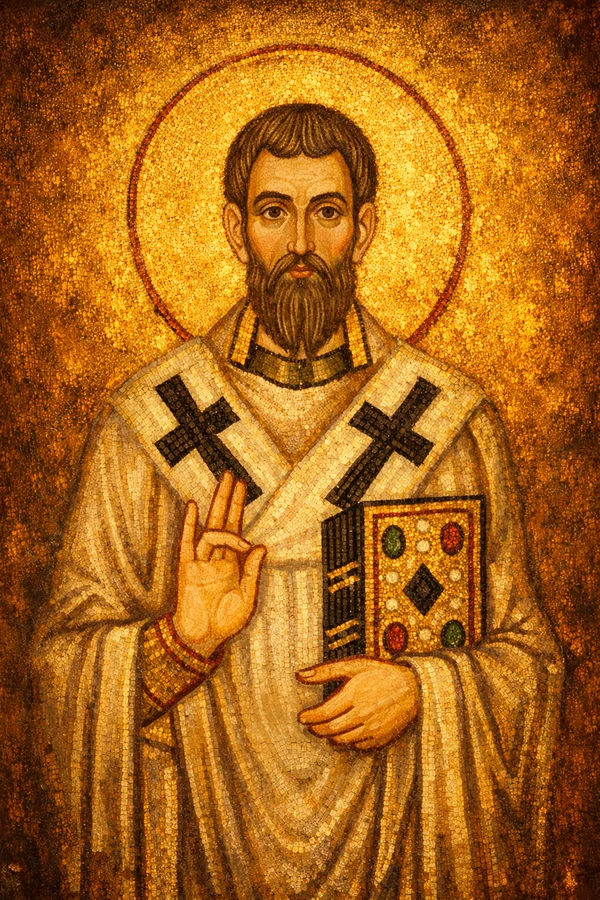
Gregory of Nyssa
Biography, major works, and key teachings
Gregory of Nyssa was the most philosophically daring of the Cappadocian Fathers — a theologian who envisioned the soul's journey into God as an infinite ascent with no final resting point.
Biography
About
Gregory of Nyssa was the most philosophically daring of the Cappadocian Fathers — a theologian who envisioned the soul's journey into God as an infinite ascent with no final resting point.
Life
The younger brother of Basil the Great, Gregory was born around 335 into the same remarkable family. Unlike Basil, he did not study abroad, and his path to the episcopate was indirect — he initially pursued a career as a rhetorician and married before being drawn into the theological struggles of his time. Basil appointed him bishop of Nyssa around 371, a position he held through periods of exile and controversy during the Arian crisis. After Basil's death in 379, Gregory emerged as a major theological voice in his own right, playing an important role at the Council of Constantinople in 381. He spent his later years writing his most profound works and died sometime after 394.
Theological Vision
Gregory's most distinctive contribution is the concept of epektasis — the soul's eternal reaching forward into the infinite depths of God. Drawing on Paul's language in Philippians 3:13 ('straining forward to what lies ahead'), Gregory taught that because God is truly infinite, the soul's growth in divine life never comes to an end. There is no final beatific plateau; perfection itself is an endless progression. This vision transforms the meaning of desire: longing for God is not a deficiency to be overcome but the very mode of participation in divine life. In the Life of Moses he traces this pattern through Moses' encounters with God — from the burning bush (light) to the cloud on Sinai (darkness) to the cleft of the rock (the hidden God) — each deeper encounter revealing that God always exceeds what the soul has grasped. Gregory also made radical claims about human nature: he taught the ultimate restoration of all things and insisted on the fundamental equality of human beings, arguing against slavery in terms that were almost unprecedented in the ancient world.
Influence
Gregory's mystical theology of infinite desire became foundational for the entire Christian contemplative tradition. His influence runs through Pseudo-Dionysius, Maximus the Confessor, and into the medieval West. His vision of epektasis — that the soul finds its rest precisely in never resting — remains one of the most original and beautiful ideas in the history of Christian thought.
Major Works
Gregory of Nyssa takes the story of Moses — the burning bush, the crossing of the Red Sea, the ascent of Sinai, the cleft of the rock — and reads it as a map of the soul's journey into God. The result is one of the most original and beautiful works in Christian theology. Gregory's key insight is that Moses' encounters with God move from light to darkness: the burning bush is luminous, but the cloud on Sinai is dark, and the final encounter happens in a cleft of rock where Moses sees only God's back as he passes by. This pattern is deliberate. The deeper the soul goes into God, the more it discovers that God exceeds every concept and image. True vision, Gregory writes, 'consists in not seeing.' And because God is infinite, the soul's desire for God can never be satisfied — not because God withholds himself, but because there is always more. This is Gregory's doctrine of epektasis: the soul's perfection is an eternal reaching forward, an endless progress into inexhaustible beauty.
Gregory of Nyssa's fifteen homilies on the Song of Songs carry forward the allegorical tradition established by Origen but push it into new territory. For Gregory, the Song is the story of the soul's infinite pursuit of the divine Beloved — a pursuit that never arrives at a final destination because the Beloved is infinite. Each moment of encounter reveals that there is always more to desire. The bride's cry 'I opened to my beloved, but my beloved had turned and gone' becomes, in Gregory's reading, not a statement of abandonment but a description of the soul's deepest experience: God is always beyond the last place we found him. These homilies are the pastoral companion to the more philosophical Life of Moses, and they speak directly to anyone who has experienced the alternation of presence and absence in prayer.
On the Soul and the Resurrection
A dialogue between Gregory of Nyssa and his dying sister Macrina on the fate of the soul after death, modeled on Plato's Phaedo — but where Socrates faces death with philosophical composure, Macrina faces it with Christian hope. Gregory arrives at her deathbed in grief; Macrina redirects him toward theology. Their conversation covers the immortality of the soul, the nature of the passions, the resurrection of the body, and the restoration of all things. Macrina emerges as the stronger theologian of the two — calm, rigorous, and unshaken. The work is both a philosophical treatise and a portrait of a remarkable woman whose intellectual life Gregory clearly regarded as equal to his own.
A systematic presentation of Christian doctrine addressing sin, redemption, the incarnation, baptism, and the Eucharist.
Quotes
Selected passages drawn from the writings of Gregory of Nyssa.
This truly is the vision of God: never to be satisfied in the desire to see Him.
Life of Moses — II.239
Every desire for the Beautiful which draws us onward is intensified by the very progress toward it.
Life of Moses — II.231
He made our nature a kind of vessel fit for the reception of his goodness, so that our desire, growing ever greater, might receive his gifts without limit.
Homilies on the Song of Songs — Homily 5
The one thing truly worthwhile is becoming God's friend.
On the Soul and the Resurrection — Adapted from conclusion
Sin is the failure to grow.
The Great Catechism — Adapted from ch. 21