Morning Prayer
— Liturgy of St. Basil
O Lord, grant that I may greet this day in peace. Help me in all things to rely upon Your holy will.
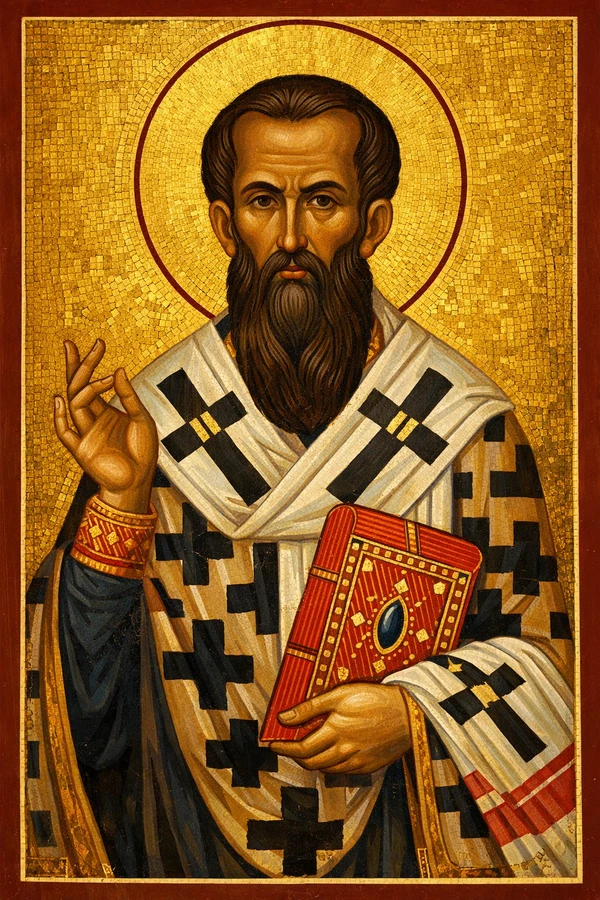
Basil the Great
Biography, major works, and key teachings
Basil the Great was the organizational genius of early Christian orthodoxy — a bishop who combined theological precision with monastic vision and radical care for the poor.
Biography
About
Basil the Great was the organizational genius of early Christian orthodoxy — a bishop who combined theological precision with monastic vision and radical care for the poor.
Life
Born around 330 into one of the most remarkable Christian families in history — his grandmother Macrina the Elder, his sister Macrina the Younger, and his brother Gregory of Nyssa are all venerated as saints — Basil received the finest classical education available, studying in Constantinople and Athens alongside Gregory of Nazianzen. After a tour of monastic communities in Egypt, Palestine, and Syria, he returned to Cappadocia and established his own monastic community. As bishop of Caesarea from 370, he navigated the treacherous politics of the Arian controversy with a combination of diplomatic cunning and theological courage, building alliances that would ultimately secure the Nicene faith. He also established the Basiliad, a vast complex of hospitals, hostels, and workshops for the poor — one of the earliest organized charitable institutions in Christian history.
Theological Vision
Basil's greatest theological achievement was his defense of the full divinity of the Holy Spirit. In On the Holy Spirit he argued that the Spirit deserves the same worship and glory as the Father and the Son — not as a created intermediary, but as fully divine. He also helped establish the crucial Trinitarian vocabulary: one ousia (essence), three hypostases (persons). This formula, developed in concert with Gregory of Nazianzen and Gregory of Nyssa, became the permanent language of Christian orthodoxy. His moral theology is equally forceful: the Hexaemeron homilies reveal a thinker who sees the beauty of creation as a direct witness to divine generosity, and his sermons on wealth insist that hoarding goods while others starve is not merely uncharitable but a form of theft.
Influence
Basil's monastic rules became the foundation of Eastern Christian monasticism and influenced Benedict's Rule in the West. His liturgical contributions survive in the Divine Liturgy of Saint Basil, still celebrated in Orthodox churches. His Trinitarian theology, forged under political pressure and personal cost, gave Christianity its enduring language for speaking about God.
Major Works
The work that secured the divinity of the Holy Spirit in Christian orthodoxy. Writing in the midst of the Arian crisis, Basil argues that the Spirit is not a subordinate creature but deserves the same worship and glory as the Father and the Son. His method is characteristically careful: rather than making direct dogmatic assertions that would provoke his opponents, he builds his case from liturgical practice, Scripture, and the logic of salvation itself — if the Spirit sanctifies, the Spirit must be divine. The treatise is also a profound meditation on tradition and how the Church knows what it knows: Basil appeals to unwritten customs transmitted alongside Scripture, arguing that the Church's lived worship carries theological authority. The result shaped not only Trinitarian doctrine but the Christian understanding of how theology and worship relate.
Nine homilies on the six days of creation in Genesis, celebrating the beauty of the natural world as a mirror of divine wisdom and generosity.
Comprehensive guidelines for the communal monastic life, covering prayer, work, obedience, and the practice of charity toward the poor.
Brief responses to questions on ascetic and communal life, forming a practical companion to the Longer Rules.
A rich collection of over three hundred letters revealing Basil's pastoral wisdom, theological convictions, and deep friendships.
Quotes
Selected passages drawn from the writings of Basil the Great.
The bread which you keep belongs to the hungry. The cloak in your closet belongs to the naked. The shoes you let rot belong to the barefoot.
Homily on Luke 12 — Homily 6
The Spirit restores paradise to us and leads us back to the kingdom of heaven.
On the Holy Spirit — 15.36