Prayer to the Trinity
— Adapted from Orations
O Trinity beyond all understanding, lead me into Your light and truth.
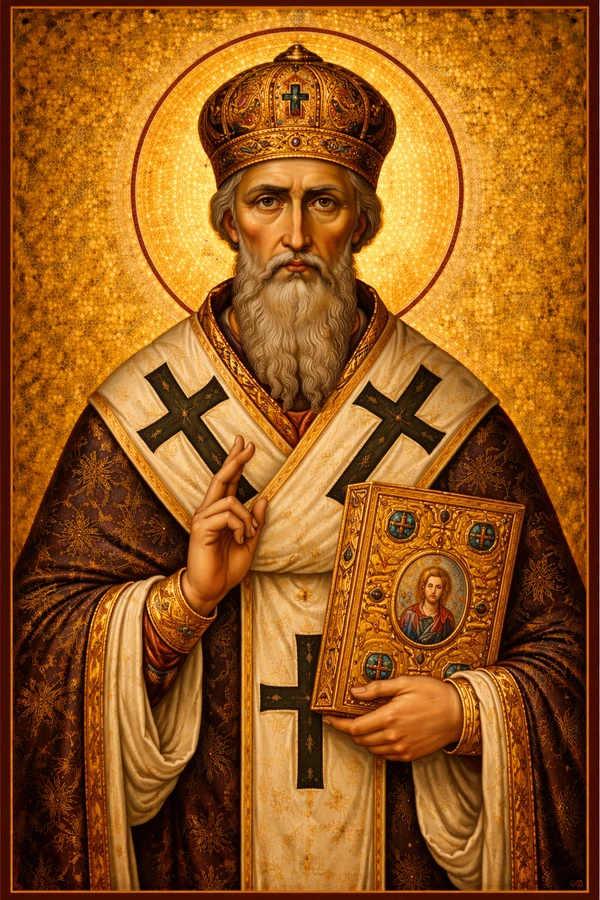
Gregory of Nazianzen
Biography, major works, and key teachings
Gregory of Nazianzen — honored in the East simply as 'The Theologian' — was the most eloquent voice of the Trinitarian settlement and a poet who found in language itself a form of prayer.
Biography
About
Gregory of Nazianzen — honored in the East simply as 'The Theologian' — was the most eloquent voice of the Trinitarian settlement and a poet who found in language itself a form of prayer.
Life
Born around 329 in Arianzus, Cappadocia, Gregory was the son of a bishop and studied rhetoric in Caesarea, Alexandria, and Athens, where his friendship with Basil the Great deepened into one of the most consequential relationships in Christian history. Unlike Basil, Gregory was temperamentally unsuited for ecclesiastical politics — he was a contemplative who longed for solitude and repeatedly tried to flee the offices thrust upon him. He was ordained a priest against his will, briefly served as bishop of the tiny see of Sasima (which he called 'a posting station on the road'), and in 379 was called to Constantinople to lead the embattled Nicene minority. There, in the small chapel of the Anastasis, he delivered the five Theological Orations that would define Trinitarian orthodoxy. He briefly presided over the Council of Constantinople in 381 before resigning under political pressure and returning home to write poetry and correspondence until his death around 390.
Theological Vision
Gregory's theology operates at the boundary of what language can do. His Theological Orations defend the full divinity of the Son and the Holy Spirit with philosophical rigor, but they also insist that God ultimately exceeds every concept and every word. He distinguished sharply between theology as an intellectual exercise and theology as an encounter with the living God — only the purified mind, he argued, can truly 'theologize.' His most famous Christological principle — 'What has not been assumed has not been healed' — became a cornerstone of the doctrine of the Incarnation, insisting that Christ must have taken on the entirety of human nature in order to redeem it. Gregory was also a poet of extraordinary range, composing thousands of lines of verse on subjects from the Trinity to his own grief and self-doubt.
Influence
Gregory's Theological Orations became the definitive expression of Nicene Trinitarian faith, shaping both Eastern and Western theology. His insistence on the limits of theological language anticipates the apophatic tradition, and his poetry — deeply personal, theologically precise — remains unmatched in Christian literature.
Major Works
Five orations delivered in a small chapel in Constantinople in 380 that became the definitive statement of Trinitarian orthodoxy. Gregory arrived in the city as the leader of a tiny Nicene minority facing Arian dominance. What he produced under that pressure was a masterpiece of theological precision and rhetorical art. The first two orations establish the conditions for genuine theology — only the purified mind can speak of God, and even then with humility. The third and fourth defend the full divinity of the Son against every Arian objection. The fifth, on the Holy Spirit, completes the picture: the Spirit is not a creature but fully God. Gregory's famous Christological principle — 'What has not been assumed has not been healed' — appears here, and his insistence that God ultimately exceeds all human concepts anticipates the entire apophatic tradition.
A broader collection of sermons on feasts, funerals, and theological controversies, revealing Gregory's rhetorical brilliance and pastoral depth.
Personal and theological letters reflecting Gregory's friendships, struggles with ecclesiastical life, and enduring pastoral concerns.
Autobiographical and theological poems, including a verse autobiography that gives rare personal insight into his life and conflicts within the Church.
Quotes
Selected passages drawn from the writings of Gregory of Nazianzen.
God always was, and is, and will be; or rather God always Is. For 'was' and 'will be' are fragments of time and of a changing nature; but He is ever existing.
Theological Orations — Oration 38.7
It is difficult to conceive God, but to define Him in words is an impossibility.
Theological Orations — Oration 28.4
Do not esteem theology to be a mere matter of words; it is a matter of purification.
Theological Orations — Oration 27.3