Prayer of Ascent
— Adapted from Itinerarium Mentis in Deum (Prologue)
Lead me, Lord, through the path of illumination, that I may pass into the fire of divine love.
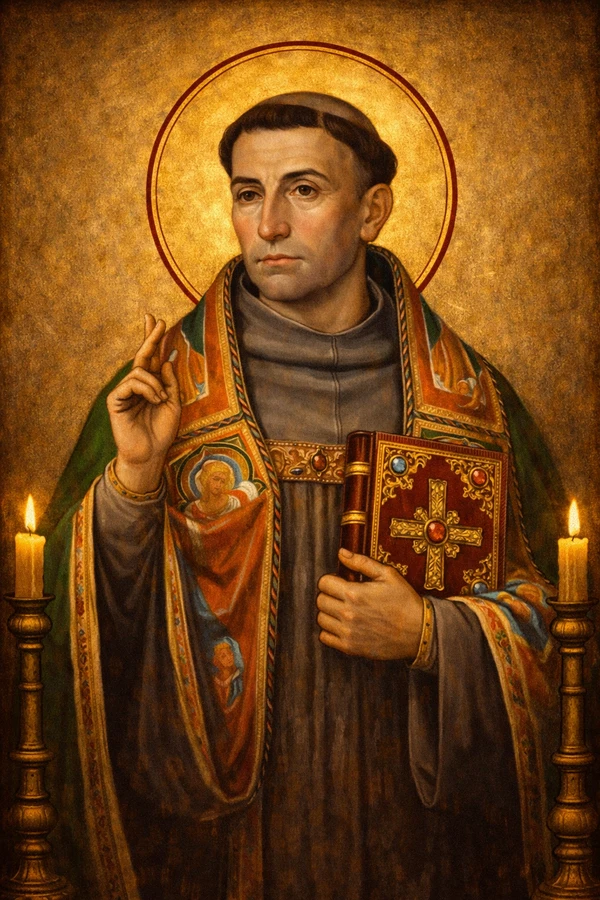
Bonaventure
Biography, major works, and key teachings
Bonaventure was the great Franciscan theologian of the thirteenth century — a thinker who mapped the soul's journey to God through creation, Scripture, and the crucified Christ.
Biography
About
Bonaventure was the great Franciscan theologian of the thirteenth century — a thinker who mapped the soul's journey to God through creation, Scripture, and the crucified Christ.
Life
Born Giovanni di Fidanza around 1221 in Bagnoregio, Italy, Bonaventure entered the Franciscan order and studied at the University of Paris, where he became a master of theology alongside Thomas Aquinas. In 1257 he was elected minister general of the Franciscan order at the age of thirty-six, tasked with holding together a community torn between radical poverty and institutional stability. He governed the order for seventeen years, writing its official biography of Francis and steering it through its deepest internal crisis. Named cardinal and bishop of Albano by Gregory X, he played a central role at the Second Council of Lyon before dying during the council in 1274. He was declared a Doctor of the Church in 1588.
Theological Vision
Bonaventure's masterwork, The Journey of the Mind to God, is a compact vision of the entire spiritual life structured as an ascent. The soul begins by contemplating God's traces in the external world — the beauty, order, and goodness of creation. It then turns inward to discover God's image in the faculties of the mind — memory, understanding, and will. Finally, it passes beyond both world and self into the divine darkness, where Christ crucified is the door. For Bonaventure, Christ is not merely the goal of the journey but its means at every step: the Word through whom creation speaks, the light by which the mind sees, and the love through which the soul is finally taken beyond itself. His theology is Franciscan to its core — rooted in wonder at creation, centered on the cross, and oriented toward ecstatic love rather than intellectual mastery.
Influence
Bonaventure offered an alternative to the Aristotelian rationalism of Aquinas — not opposed to reason, but insisting that reason alone cannot complete the journey. His influence shaped Franciscan spirituality, the devotio moderna, and later thinkers who emphasized the affective and experiential dimensions of faith. The Journey of the Mind to God remains one of the most beautiful short works in Christian theology.
Major Works
The Journey of the Mind to God
A short work of extraordinary density and beauty, composed in 1259 on Mount La Verna — the mountain where Francis of Assisi received the stigmata. Bonaventure structures the soul's ascent in six stages, corresponding to the six wings of the Seraph that appeared to Francis. The soul begins by contemplating God's traces in the external world — beauty, order, goodness — then turns inward to discover God's image in the mind's own faculties. The final stages pass beyond both world and self into the divine mystery, where Christ crucified is the door. Bonaventure insists that this journey cannot be completed by intellect alone: 'If you wish to know how these things come about, ask grace, not instruction; desire, not understanding.' The Journey is compact enough to read in a single sitting, but it maps the entire arc of the spiritual life — from wonder at creation to ecstatic union — with the precision of a master architect.
A Franciscan meditation on the life, passion, and glory of Christ, structured as a tree bearing twelve fruits for contemplation.
A scholarly commentary on Peter Lombard's Sentences, integrating Aristotelian philosophy and Augustinian theology within the Franciscan tradition.
A systematic summary of Christian theology, covering creation, sin, incarnation, grace, the sacraments, and the last things.
Quotes
Selected passages drawn from the writings of Bonaventure.
If you wish to know how these things come about, ask grace, not instruction; desire, not understanding; the groaning of prayer, not diligent reading.
The Journey of the Mind to God — VII.6
In this passing over, Christ is the way and the door, the ladder and the vehicle.
The Journey of the Mind to God — VII.1
Whoever turns to look at the Crucified with full faith, hope, and love — such a one makes the Passover with Christ.
The Journey of the Mind to God — VII.2