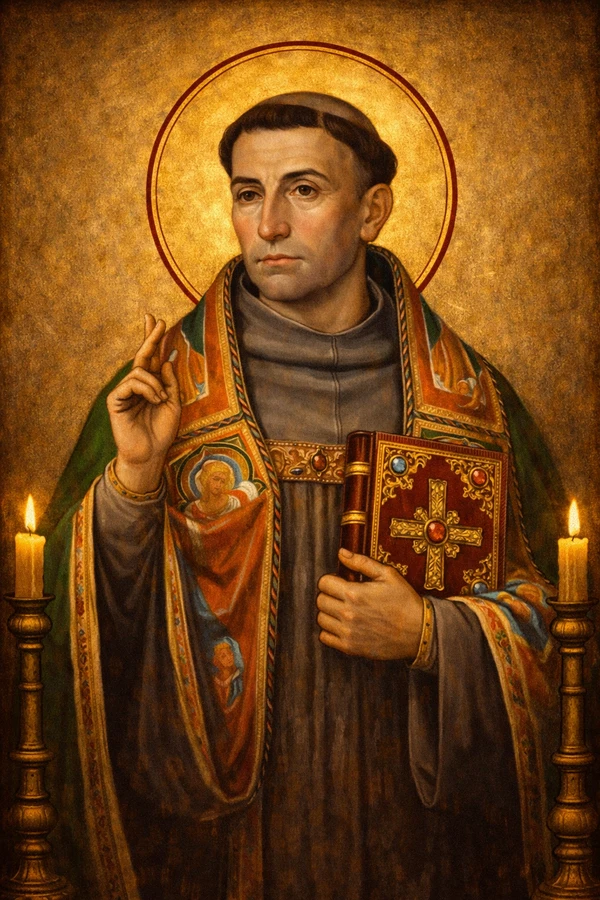
BONAVENTURE · 13TH CENTURY · FRANCISCAN
The Journey of the Mind to God
Summary and key themes of this work
A short work of extraordinary density and beauty, composed in 1259 on Mount La Verna — the mountain where Francis of Assisi received the stigmata. Bonaventure structures the soul's ascent in six stages, corresponding to the six wings of the Seraph that appeared to Francis. The soul begins by contemplating God's traces in the external world — beauty, order, goodness — then turns inward to discover God's image in the mind's own faculties. The final stages pass beyond both world and self into the divine mystery, where Christ crucified is the door. Bonaventure insists that this journey cannot be completed by intellect alone: 'If you wish to know how these things come about, ask grace, not instruction; desire, not understanding.' The Journey is compact enough to read in a single sitting, but it maps the entire arc of the spiritual life — from wonder at creation to ecstatic union — with the precision of a master architect.
The Journey of the Mind to God is a central text in the Christian mystical tradition, offering insight into the spiritual life, the nature of divine union, and the transformation of the soul.
This work is central to the Franciscan tradition, shaping the understanding of the spiritual life and the soul's journey toward union with God.
Selected Passages
No one enters into himself unless Christ be his guide.
If you wish to know how these things come about, ask grace, not instruction; desire, not understanding; the groaning of prayer, not diligent reading.
In this passing over, Christ is the way and the door, the ladder and the vehicle.
Read the Work (Free)
Buy a Copy (Optional)
Some links (such as Amazon) may be affiliate links.
This supports the site at no extra cost to you.