Our Hearts Are Restless
— Confessions I.1
You have made us for Yourself, O Lord, and our hearts are restless until they rest in You.
More Prayers
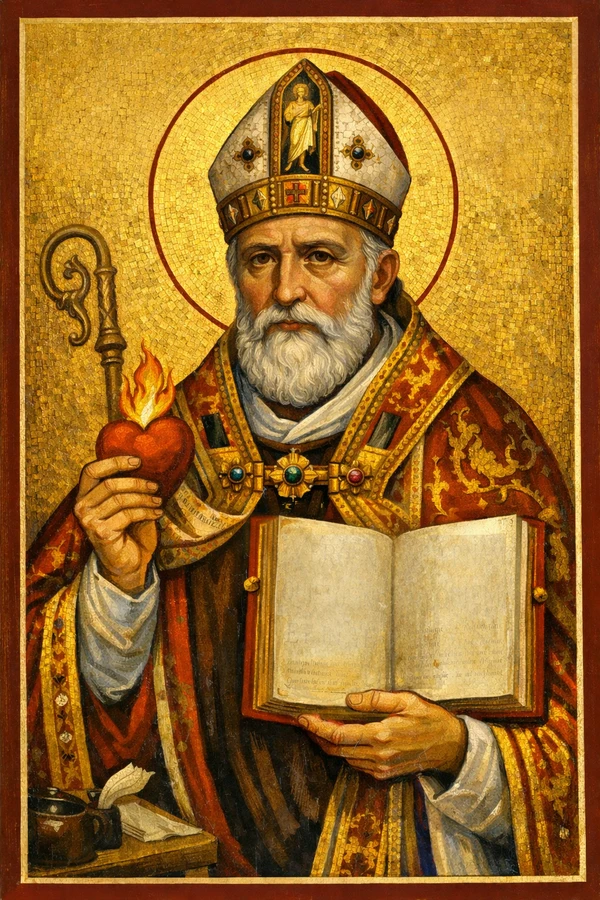
Augustine of Hippo
Biography, major works, and key teachings
Augustine of Hippo was the most influential theologian in Western Christianity — a restless intellect whose conversion from rhetoric and Manichaeism to Catholic faith produced writings that shaped every subsequent century of Christian thought.
Biography
About
Augustine of Hippo was the most influential theologian in Western Christianity — a restless intellect whose conversion from rhetoric and Manichaeism to Catholic faith produced writings that shaped every subsequent century of Christian thought.
Life
Born in 354 in Thagaste, Roman North Africa, Augustine was raised by a pagan father and a fiercely devout Christian mother, Monica. He excelled in rhetoric and spent his twenties pursuing philosophical satisfaction — first through Manichaeism, then Neoplatonism — while living with a companion and fathering a son, Adeodatus. His conversion came in a Milan garden in 386, catalyzed by the preaching of Ambrose, the prayers of Monica, and the words of Paul. He was baptized the following Easter. Returning to Africa, he was ordained a priest almost against his will and became bishop of Hippo in 396, a position he held for thirty-four years until his death in 430, as the Vandals besieged the city.
Theological Vision
Augustine's theology begins in the interior life — the restless heart that finds no peace apart from God. In the Confessions he mapped the landscape of memory, desire, and grace with an honesty that had no precedent in Christian literature. In On the Trinity he explored how the human mind itself — memory, understanding, and will — reflects the triune God. His theology of grace insists that the soul cannot ascend to God by its own power; it must be drawn. This conviction, born from his own experience of delayed conversion, became the foundation of Western teaching on grace and free will. Yet Augustine was also a mystic: his account of the vision at Ostia, shared with Monica shortly before her death, describes a momentary touching of divine Wisdom that transcends all created things.
Influence
No single Christian thinker has exercised a wider influence. Augustine's theology of grace shaped the medieval Church, divided the Reformation, and continues to frame debates in Catholic, Protestant, and philosophical theology. The Confessions invented a genre — the spiritual autobiography. The City of God provided the West with its theology of history. His reflections on time, language, and interiority anticipated concerns that would not surface again until Descartes, Wittgenstein, and Heidegger.
Major Works
The first great spiritual autobiography in Western literature. Augustine traces his path from a restless youth in North Africa — through Manichaeism, Neoplatonism, and a career in rhetoric — to the moment of conversion in a Milan garden. But the Confessions is far more than a memoir. It is a sustained meditation on memory, time, desire, and the mystery of a God who was always closer than Augustine knew. The famous opening — 'You have made us for yourself, and our heart is restless until it rests in you' — sets the key for the entire work: the human heart is made for something it cannot provide for itself. Books I–IX tell the story; Book X plunges into the philosophy of memory; Books XI–XIII offer a reading of Genesis that becomes a meditation on the nature of time itself. No other book in the Christian tradition combines this depth of personal honesty with this reach of philosophical ambition.
Augustine's largest and most ambitious work, written over thirteen years in response to the sack of Rome by the Visigoths in 410. The charge was devastating: Rome fell because it abandoned its old gods for Christianity. Augustine's answer is a complete theology of history. He distinguishes two cities — the city of God, founded on love of God, and the earthly city, founded on love of self — and traces their intertwined histories from creation to the last judgment. The first ten books dismantle Roman religion and philosophy with forensic precision. The last twelve construct a Christian vision of time, providence, and human destiny. The City of God is vast, sometimes sprawling, and occasionally digressive, but its central insight remains powerful: no earthly civilization is ultimate, and the deepest human loyalties must be placed beyond the reach of any empire's collapse.
Augustine spent two decades on this work, and the effort shows. On the Trinity is the most sustained exploration of the triune God in Western theology. The first seven books expound the scriptural and doctrinal foundations; the later books turn inward, searching for analogies of the Trinity in the human mind itself — in memory, understanding, and will. Augustine is the first Christian thinker to systematically explore the mind as an image of the Trinity, and his conclusions shaped every subsequent Western treatment of the doctrine. The work is difficult, honest about its own difficulties, and occasionally luminous. Augustine himself was unsatisfied with it — it was published against his wishes after a draft was circulated prematurely — but its influence has been incalculable.
A compact handbook on faith, hope, and love, summarizing Christian doctrine in response to questions from a friend named Laurentius.
A foundational guide to interpreting Scripture and communicating Christian truth, blending hermeneutics with classical rhetoric.
Quotes
Selected passages drawn from the writings of Augustine of Hippo.
You have made us for yourself, O Lord, and our heart is restless until it rests in you.
Confessions — I.1
Late have I loved you, beauty so ancient and so new, late have I loved you! You were within me, but I was outside.
Confessions — X.27
If you understood Him, it would not be God.
Sermon 52 — 6.16
You called and cried out loud and shattered my deafness. You were radiant and resplendent, you put to flight my blindness.
Confessions — X.27
In my deepest wound I saw your glory, and it dazzled me.
Confessions — VII.10 (adapted)