From the German Sermons
— Adapted from Adapted from German Sermon 52 (on spiritual poverty)
God, rid me of God, that I may find you not as I conceive you nor as I name you nor as I worship you, but as you are in yourself: the silent ground beneath all that can be thought or spoken.
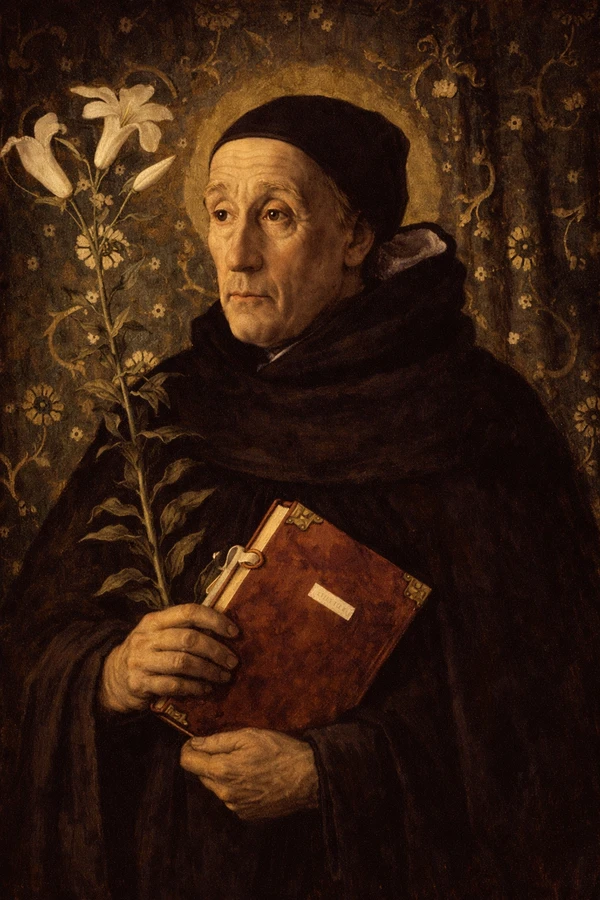
Meister Eckhart
Biography, major works, and key teachings
Meister Eckhart was the most daring and original mystic of the medieval West — a Dominican preacher and philosopher whose sermons on detachment, the birth of the Word in the soul, and the 'ground' beyond God have influenced every subsequent generation of Christian contemplatives.
Biography
About
Meister Eckhart was the most daring and original mystic of the medieval West — a Dominican preacher and philosopher whose sermons on detachment, the birth of the Word in the soul, and the 'ground' beyond God have influenced every subsequent generation of Christian contemplatives.
Life
Born around 1260 near Erfurt in Thuringia, Eckhart entered the Dominican order as a teenager. He rose rapidly through the order's intellectual ranks: prior at Erfurt, master of theology at Paris (a distinction previously held only by Thomas Aquinas), provincial of Saxony, vicar-general of Bohemia, and professor at Strasbourg and Cologne. He was equally at home in the Latin lecture hall and the vernacular pulpit, and it was his German sermons — delivered to Dominican nuns, Beguine communities, and lay audiences — that made him the most famous preacher of his age. In the 1320s, amid tensions between the Dominican and Franciscan orders, the Archbishop of Cologne initiated heresy proceedings against him. Eckhart appealed to the pope and traveled to Avignon to defend himself. He died around 1328, probably before the verdict was delivered. In 1329, Pope John XXII condemned twenty-eight propositions drawn from his writings. Eckhart was never personally condemned as a heretic, and in 1992 the Vatican confirmed that he is 'a good and orthodox theologian.'
Theological Vision
Eckhart's mystical theology centers on three interconnected ideas. First, Gelassenheit — releasement or detachment — the radical letting-go of all created things, all self-will, and even all images of God, so that the soul becomes empty enough to receive God directly. Second, the birth of the Word in the soul: Eckhart teaches that the same eternal act by which the Father generates the Son in the Trinity is replicated in the ground of the human soul when it achieves true detachment. The soul does not merely contemplate God; God is born in the soul. Third, the distinction between 'God' and the 'Godhead' (Gottheit): beyond the God who creates and redeems lies the desert of the Godhead — the absolute, undifferentiated ground of all being, beyond all names and concepts. Eckhart's language is deliberately paradoxical, designed to shatter the mind's habitual categories and force it into an encounter it cannot control. His intellectual lineage runs through Augustine, Pseudo-Dionysius, and Aquinas, but his voice is entirely his own.
Influence
Eckhart's influence is vast and complex. His immediate disciples — Johannes Tauler and Heinrich Suso — softened his most radical formulations while preserving his contemplative vision. The anonymous author of The Cloud of Unknowing draws on the same apophatic tradition. Martin Luther studied him. The Romantics rediscovered him. In the twentieth century, his thought attracted comparison with Zen Buddhism and Advaita Vedanta, and theologians from Karl Rahner to Bernard McGinn have rehabilitated his reputation. He remains the most searched-for Christian mystic on the internet, and his sermons — addressed to ordinary people in their own language — continue to challenge and transform readers who encounter them.
Major Works
The works for which Eckhart is most famous — over a hundred sermons delivered in the vernacular to Dominican nuns, Beguine communities, and lay audiences throughout the Rhineland. These are not devotional homilies but philosophical explosions: Eckhart uses paradox, negation, and startling imagery to shatter his listeners' habitual concepts of God and self. The sermons on spiritual poverty (especially Sermon 52, 'Blessed are the poor in spirit') and on the birth of the Word in the soul (Sermons 1–4) represent the summit of medieval German mysticism. Eckhart was the first major thinker to do serious theology in German, and he essentially created the philosophical vocabulary of the language in the process.
Eckhart's earliest surviving work, a set of spiritual instructions delivered to young Dominican novices at Erfurt in the 1290s. More practical and less paradoxical than the later sermons, the Talks address obedience, self-denial, the nobility of the will, and the practice of finding God in all things. They offer the clearest window into Eckhart as a spiritual director — patient, wise, and deeply attentive to the struggles of those beginning the contemplative life.
The Book of Divine Consolation
Written around 1308 for Agnes of Hungary after the murder of her father, this treatise offers a theology of suffering grounded in Eckhart's metaphysics of detachment. True consolation, Eckhart argues, comes not from changing external circumstances but from discovering the ground of the soul where God dwells beyond all suffering. The work is both tender and demanding — it does not minimize grief but insists that beneath every loss lies a reality that cannot be lost.
Quotes
Selected passages drawn from the writings of Meister Eckhart.
The eye through which I see God is the same eye through which God sees me; my eye and God's eye are one eye, one seeing, one knowing, one love.
German Sermons — Sermon 12 (Walshe)
God is at home. It is we who have gone out for a walk.
German Sermons — Sermon 69 (Walshe)
God must act and pour himself into you the moment he finds you ready.
German Sermons — Sermon 4 (Walshe)