On Loving God
— Adapted from De Diligendo Deo
Lord, let me love You for Yourself alone, and find in You my rest and my joy.
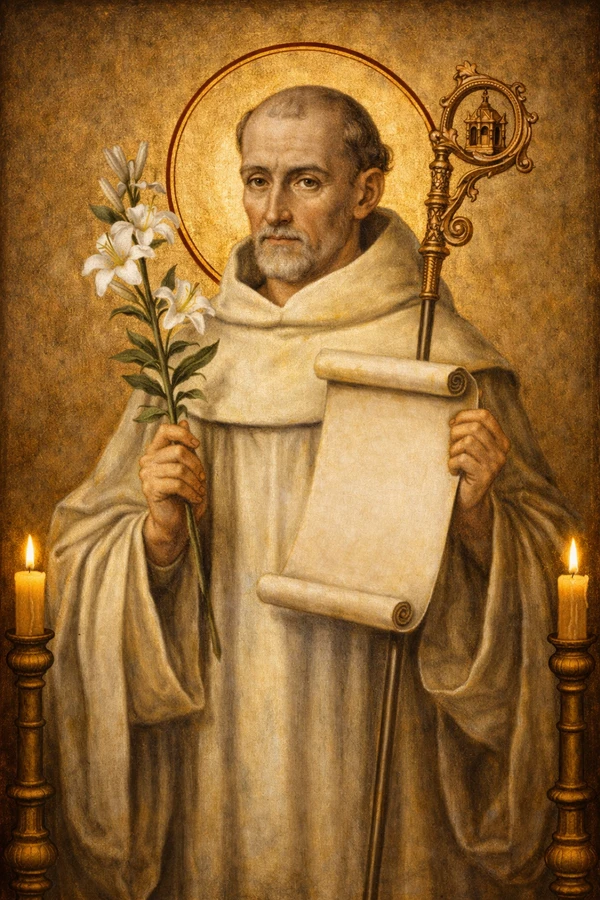
Bernard of Clairvaux
Biography, major works, and key teachings
Bernard of Clairvaux was the most influential Christian voice of the twelfth century — a Cistercian monk whose sermons on the Song of Songs became the supreme expression of medieval love-mysticism.
Biography
About
Bernard of Clairvaux was the most influential Christian voice of the twelfth century — a Cistercian monk whose sermons on the Song of Songs became the supreme expression of medieval love-mysticism.
Life
Born in 1090 to a noble Burgundian family, Bernard entered the struggling monastery of Cîteaux at twenty-two, bringing with him thirty relatives and friends he had personally recruited. Within three years he was sent to found a new monastery at Clairvaux, which he led for the rest of his life. From this remote valley he became the most powerful churchman in Europe — advising popes, arbitrating disputes between kings, preaching the Second Crusade, and combating the theological rationalism of Peter Abelard. Yet he remained a monk: his letters reveal a man perpetually torn between the demands of public life and his longing for the silence of the cloister. He died in 1153, having founded sixty-eight monasteries.
Theological Vision
Bernard's theology is a theology of desire. In his eighty-six Sermons on the Song of Songs — a life's work left unfinished at his death — he reads the biblical love poem as the drama of the soul's longing for God and God's longing for the soul. Love, for Bernard, is not merely an emotion but the very substance of the spiritual journey: the soul moves from self-interested love through love of God for the self's sake to love of God for God's own sake, and finally to love of self only in God. His treatise On Loving God articulates this progression with a directness that still startles: the reason for loving God is God himself, and the measure of that love is to love without measure. Bernard also developed a profound devotion to the humanity of Christ — to the wounds, the suffering, the tenderness of the Incarnate Word — that shaped Western piety for centuries.
Influence
Bernard's love-mysticism shaped the entire trajectory of Western contemplative theology, influencing the Victorines, the Rhineland mystics, Ignatius of Loyola, and Francis de Sales. Dante placed him as the final guide in the Paradiso — the one who leads the pilgrim to the Beatific Vision. His sermons remain among the richest spiritual writings in the Christian tradition.
Major Works
Eighty-six sermons delivered to his monks over eighteen years — left unfinished at Bernard's death, reaching only the beginning of the third chapter of the Song of Songs. This is not a deficiency but the point: the Song, for Bernard, is inexhaustible because the love it describes is inexhaustible. Bernard reads the biblical love poem as the drama of the soul's relationship with Christ the divine Bridegroom. The kiss of the mouth is the gift of contemplation. The wounds of love are the marks of transformation. The beloved's absence is the painful but necessary withdrawal that deepens desire. The sermons move between exegesis, pastoral counsel, and moments of extraordinary lyrical power. Bernard is candid about his own experience — he describes moments when the Word has visited his soul and moments when the Word has withdrawn — with a directness that makes the mystical life feel not remote but intimate and human.
The definitive statement of Bernard's love-mysticism, and one of the most concentrated meditations on desire in the Christian tradition. Bernard asks a simple question — why should we love God? — and gives an answer that unfolds across four degrees of love. The soul begins by loving itself for its own sake, then learns to love God for the benefits God gives, then rises to love God for God's own sake, and finally reaches a state where it loves even itself only in God. This last degree, Bernard admits, he is not sure can be fully achieved in this life — but the reaching toward it is the substance of the spiritual journey. The prose is tight, warm, and utterly free of abstraction. Bernard's famous line — 'The measure of loving God is to love him without measure' — captures the paradox: love has no natural limit, because its object is infinite. This short treatise can be read in an afternoon, but its vision of love as the organizing principle of all reality repays a lifetime of reflection.
Counsel addressed to Pope Eugenius III on the interior life, warning against the dangers of busyness and urging contemplative self-knowledge.
Apology to William of St. Thierry
A spirited defense of Cistercian simplicity and austerity, written in contrast to the elaborate ornament of Cluniac monasticism.
Quotes
Selected passages drawn from the writings of Bernard of Clairvaux.
The reason for loving God is God Himself. The measure of this love is to love without measure.
On Loving God — I.1
Love is sufficient in itself; it pleases by itself and for its own sake. It is itself a merit and its own reward.
On Loving God — VII.17
I have loved because I have loved; I have loved that I might love.
Sermons on the Song of Songs — Sermon 83.4
There are those who seek knowledge for the sake of knowledge: that is curiosity. There are those who seek knowledge to be known by others: that is vanity. But there are also those who seek knowledge in order to serve: that is love.
Sermons on the Song of Songs — Sermon 36.3
You wish to see; listen. Hearing is a step toward vision.
Sermons on the Song of Songs — Sermon 28 (adapted)
Humility is the mother of salvation.
On Consideration — II.7 (adapted)