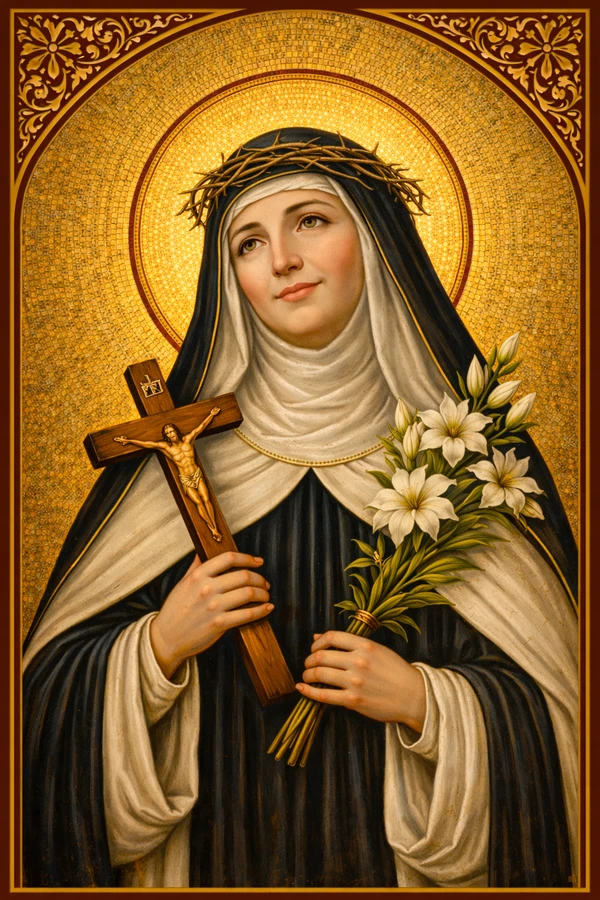
CATHERINE OF SIENA · 14TH CENTURY · DOMINICAN
The Dialogue
Summary and key themes of this work
Catherine of Siena's great mystical work, dictated during a series of ecstasies in 1378, structured as a conversation between the soul and God the Father. At its center is the image of Christ as a bridge — the only passage between the abyss of human fallenness and the life of God. The Dialogue is divided into four treatises covering discretion, prayer, providence, and obedience, but its real power lies in the directness of its voice. God speaks to Catherine with an intimacy that is startling: 'I am He who is; you are she who is not.' This is not cruelty — it is the ground of mystical freedom. Catherine's God is passionately involved with creation, grieved by the Church's corruption, and relentless in calling souls toward love. The work combines visionary theology with the most concrete practical demands: love of God that does not become love of neighbor is self-deception. Catherine dictated the entire work while barely eating or sleeping, and it bears the marks of that intensity on every page.
The Dialogue is a central text in the Christian mystical tradition, offering insight into the spiritual life, the nature of divine union, and the transformation of the soul.
This work is central to the Dominican tradition, shaping the understanding of the spiritual life and the soul's journey toward union with God.
Selected Passages
All the way to heaven is heaven, because Jesus said: I am the way.
You, eternal Trinity, are a deep sea, into which the more I enter, the more I find, and the more I find, the more I seek you.
I am He who is; you are she who is not.
Read the Work (Free)
Buy a Copy (Optional)
Some links (such as Amazon) may be affiliate links.
This supports the site at no extra cost to you.