Prayer to the Trinity
— The Dialogue
O eternal Trinity, you are a deep sea, into which the more I enter, the more I find.
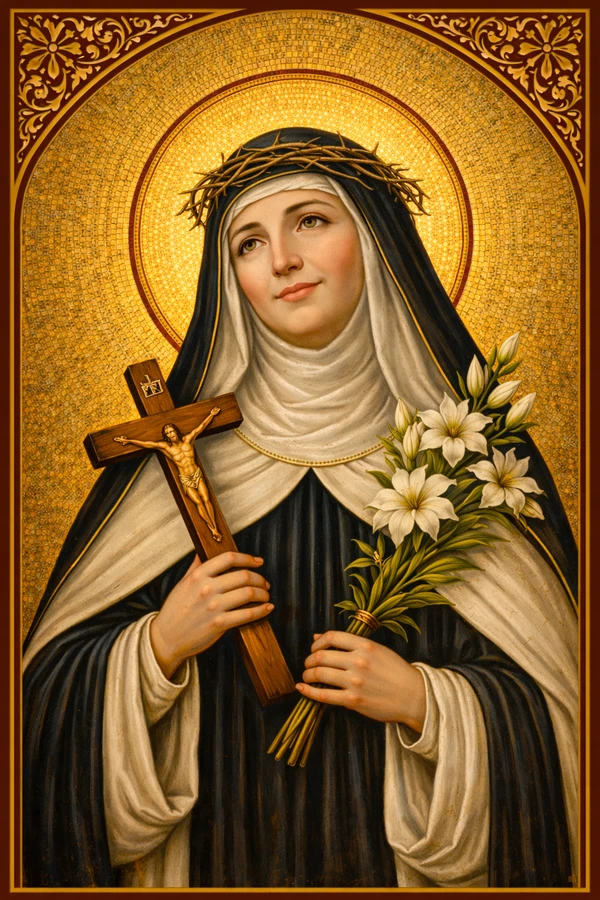
Catherine of Siena
Biography, major works, and key teachings
Catherine of Siena was a Dominican mystic, political reformer, and Doctor of the Church — a woman without formal education who became one of the most forceful voices in fourteenth-century Christendom.
Biography
About
Catherine of Siena was a Dominican mystic, political reformer, and Doctor of the Church — a woman without formal education who became one of the most forceful voices in fourteenth-century Christendom.
Life
Born in 1347 as the twenty-fourth of twenty-five children of a Sienese dyer, Catherine experienced mystical visions from early childhood and at sixteen joined the Dominican Third Order as a mantellata — living under religious vows while remaining in her family home. After three years of near-total solitude and intense prayer, she emerged into public life with an authority that startled everyone around her. She gathered a circle of followers — priests, nobles, artists, and ordinary citizens — whom she called her famiglia. She dictated hundreds of letters to popes, kings, mercenary captains, and prostitutes with equal directness. She traveled to Avignon to confront Pope Gregory XI in person and played a decisive role in persuading him to return the papacy to Rome. She died in 1380 at thirty-three, physically exhausted by her austerities and her labors for the Church.
Theological Vision
Catherine's theology, dictated in The Dialogue during a series of ecstatic experiences in 1378, is structured as a conversation between the soul and God the Father. Its central image is Christ as a bridge between heaven and earth — a bridge the soul crosses through self-knowledge, prayer, and love. God tells Catherine that He is 'He who is,' and she is 'she who is not' — a formulation that sounds harsh but expresses the deepest mystical insight: that apart from God, the self has no independent being. Her understanding of the spiritual life is intensely Christocentric and intensely practical. She insisted that contemplation must bear fruit in action, that love of God without love of neighbor is self-deception, and that the Church's corruption demanded not abandonment but reform from within. Her letters — passionate, sometimes fierce, always specific — reveal a mind that moved effortlessly between mystical vision and political strategy.
Influence
Catherine was declared a Doctor of the Church in 1970 — only the second woman to receive the title. Her influence extends across mystical theology, ecclesiology, and the theology of reform. She demonstrated that contemplative depth and prophetic action are not opposed but inseparable, and her Dialogue remains one of the great works of Christian mysticism.
Major Works
Catherine of Siena's great mystical work, dictated during a series of ecstasies in 1378, structured as a conversation between the soul and God the Father. At its center is the image of Christ as a bridge — the only passage between the abyss of human fallenness and the life of God. The Dialogue is divided into four treatises covering discretion, prayer, providence, and obedience, but its real power lies in the directness of its voice. God speaks to Catherine with an intimacy that is startling: 'I am He who is; you are she who is not.' This is not cruelty — it is the ground of mystical freedom. Catherine's God is passionately involved with creation, grieved by the Church's corruption, and relentless in calling souls toward love. The work combines visionary theology with the most concrete practical demands: love of God that does not become love of neighbor is self-deception. Catherine dictated the entire work while barely eating or sleeping, and it bears the marks of that intensity on every page.
Nearly four hundred letters to popes, queens, and ordinary believers, remarkable for their prophetic urgency and depth of mystical insight.
Twenty-six prayers composed and dictated by Catherine, expressing her mystical union with God and fervent intercession for the Church.
Quotes
Selected passages drawn from the writings of Catherine of Siena.
You, eternal Trinity, are a deep sea, into which the more I enter, the more I find, and the more I find, the more I seek you.
The Dialogue — Chapter 167
Be who God meant you to be, and you will set the world on fire.
Letters — Attributed (widely circulated)