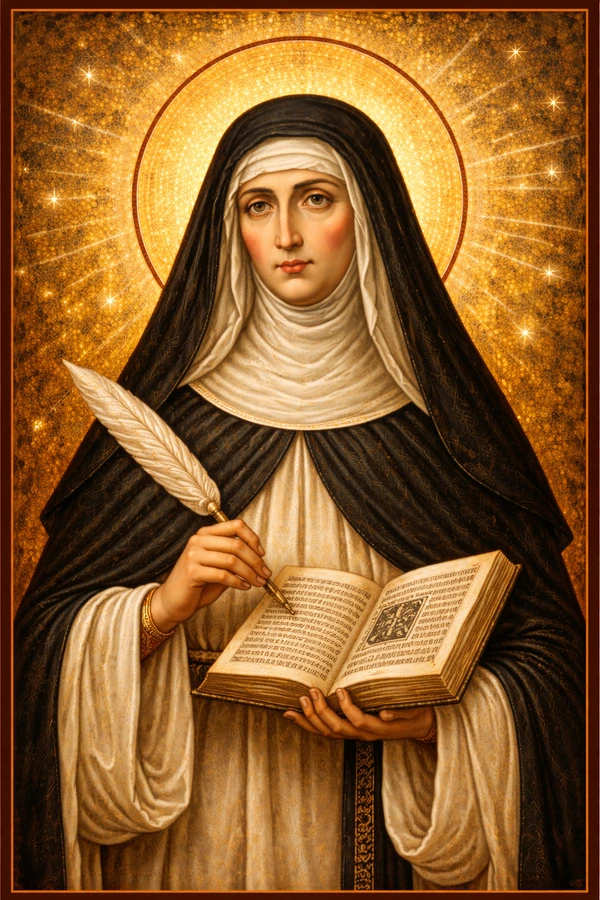
HILDEGARD OF BINGEN · 12TH CENTURY · BENEDICTINE
Scivias
Summary and key themes of this work
Hildegard's first and most visionary work, composed over ten years beginning in 1141 after she received divine command to 'write what you see and hear.' The Scivias — an abbreviation of Scito vias Domini, 'Know the Ways of the Lord' — records twenty-six visions organized in three parts: creation and the fall, redemption through Christ, and the ordering of the Church and the cosmos. Each vision is described in vivid, sometimes startling imagery — cosmic eggs, rivers of fire, living light, winged figures — followed by Hildegard's theological interpretation. The result is unlike anything else in Christian literature: a work that is simultaneously prophetic, systematic, and intensely visual. Hildegard sees the universe as a living whole, sustained by the breath of God, and the human person as a microcosm of that whole. The Scivias was approved by Pope Eugenius III on the recommendation of Bernard of Clairvaux, securing Hildegard's authority as a visionary at the highest level of the Church.
Scivias is a central text in the Christian mystical tradition, offering insight into the spiritual life, the nature of divine union, and the transformation of the soul.
This work is central to the Benedictine tradition, shaping the understanding of the spiritual life and the soul's journey toward union with God.
Selected Passages
The Word is living, being, spirit, all verdant greening, all creativity.
Humanity, take a good look at yourself. Inside you've got heaven and earth, and all of creation. You are a world — everything is hidden in you.
The soul is like a wind that waves over herbs, is like the dew that moistens the grass, is like the rainy air that makes things grow. In the same way, you should flow forth with gentleness to all who are in need.
Read the Work (Free)
Buy a Copy (Optional)
Some links (such as Amazon) may be affiliate links.
This supports the site at no extra cost to you.