O Fire of the Spirit
— Symphonia
O fire of the Spirit, Paraclete, life of the life of all creation.
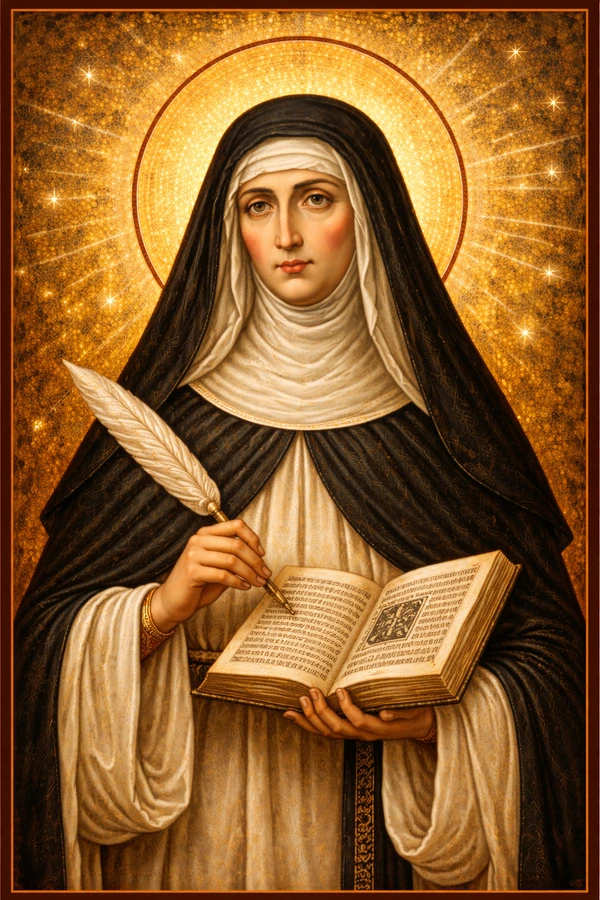
Hildegard of Bingen
Biography, major works, and key teachings
Hildegard of Bingen was a Benedictine abbess, visionary, composer, naturalist, and Doctor of the Church — a woman of staggering creative range who saw the cosmos as a living expression of the divine Word.
Biography
About
Hildegard of Bingen was a Benedictine abbess, visionary, composer, naturalist, and Doctor of the Church — a woman of staggering creative range who saw the cosmos as a living expression of the divine Word.
Life
Born in 1098 in the Rhineland as the tenth child of a noble family, Hildegard was given to the Church as a tithe at the age of eight, placed in the care of the anchoress Jutta at the monastery of Disibodenberg. She took vows as a Benedictine nun and, after Jutta's death, became magistra of the growing community. At forty-two she received a vision she described as a 'living light' and, after much hesitation and encouragement from her confessor and Pope Eugenius III, began recording her visions in the Scivias. She went on to found her own monastery at Rupertsberg, near Bingen, and a second at Eibingen. She composed an extraordinary body of liturgical music, wrote treatises on medicine and natural history, invented an artificial language, conducted four preaching tours throughout Germany (remarkable for a woman of her era), and corresponded with emperors, popes, and abbots. She died in 1179 at eighty-one and was declared a Doctor of the Church by Benedict XVI in 2012.
Theological Vision
Hildegard's theology is fundamentally cosmic and musical. Her key concept is viriditas — 'greening power' — the life-giving energy that flows from the divine Word into all creation. For Hildegard, the universe is not inert matter but a living song, and humanity stands at the center of this cosmic symphony, created to mirror and complete the praise of creation. Her visions, recorded in the Scivias, Liber Vitae Meritorum, and Liber Divinorum Operum, present stunning images of the cosmos, the Church, and the human soul as interconnected expressions of divine wisdom. She saw the Incarnation as the culmination of this cosmic pattern: God becoming flesh is the ultimate act of viriditas, the greening of the world from within. Her theology is sensory and embodied in a way that sets her apart from the more abstract mystical traditions — she insists that the body, the senses, and the material world are not obstacles to God but bearers of divine presence.
Influence
Hildegard's influence, largely forgotten for centuries, has experienced a remarkable revival. Her music is widely performed and recorded. Her ecological theology — her insistence that creation is a living whole sustained by divine energy — speaks directly to contemporary concerns. She stands as one of the most original voices in the Christian tradition, defying every category her era would have imposed on her.
Major Works
Hildegard's first and most visionary work, composed over ten years beginning in 1141 after she received divine command to 'write what you see and hear.' The Scivias — an abbreviation of Scito vias Domini, 'Know the Ways of the Lord' — records twenty-six visions organized in three parts: creation and the fall, redemption through Christ, and the ordering of the Church and the cosmos. Each vision is described in vivid, sometimes startling imagery — cosmic eggs, rivers of fire, living light, winged figures — followed by Hildegard's theological interpretation. The result is unlike anything else in Christian literature: a work that is simultaneously prophetic, systematic, and intensely visual. Hildegard sees the universe as a living whole, sustained by the breath of God, and the human person as a microcosm of that whole. The Scivias was approved by Pope Eugenius III on the recommendation of Bernard of Clairvaux, securing Hildegard's authority as a visionary at the highest level of the Church.
Visions presenting a dialogue between virtues and vices, offering a moral theology grounded in Hildegard's cosmic vision of creation and healing.
Her final visionary work, presenting a cosmic vision of creation, the human person, and history under the governance of the divine Word.
Nearly four hundred letters to emperors, popes, abbots, and abbesses, combining prophetic admonition with warmth and pastoral wisdom.
Quotes
Selected passages drawn from the writings of Hildegard of Bingen.